Ferrol, Galicia
From Wikipedia, the free encyclopedia
| Ferrol |
| — Municipality — |
|
Ferrol Port |
|
|
Location of the municipality of Ferrol within Galicia |
|
Location of Ferrol within Spain.
|
Coordinates:  43°28′N 8°15′WCoordinates: 43°28′N 8°15′W 43°28′N 8°15′WCoordinates: 43°28′N 8°15′W |
| Country |
Spain |
| Region |
Galicia |
| Province |
A Coruña |
| County |
Ferrol |
| Fishing Village |
1st century BC |
| Christian Outpost |
8th century |
| Royal Arsenal |
16th century |
| Royal Dockyard |
18th century |
| Parishes |
Brión, A Cabana, Covas, Doniños, Esmelle, Ferrol, A Graña, Leixa, Mandiá, Marmancón, A Mariña, Trasancos, Serantes |
| Government |
| • Type |
Mayor-council |
| • Body |
Concello de Ferrol |
| • Mayor |
José Manuel Rey Varela (PPdeG) |
| Area |
| • Total |
81.9 km2 (31.6 sq mi) |
| Population (2009)INE |
| • Total |
74,273 |
| Demonym |
ferrolan (m), ferrolana (f) |
| Time zone |
CET (GMT +1) |
| • Summer (DST) |
CEST (GMT +2) (UTC) |
| Postcode |
15401 - 15406 |
| Area code(s) |
+34 981 |
| Website |
http://www.ferrol.es/ |
Ferrol (
Galician pronunciation: [feˈrɔl]), sometimes in Spanish
El Ferrol, is a city in the
Province of A Coruña in
Galicia, located on the
Atlantic coast in north-western
Spain. As of 2007, it has an urban population of 77,859 and a metropolitan area population of over 241,528.
The city has been a major naval shipbuilding centre for most of its history, being the capital of the
Spanish Navy's
Maritime Department of the North since the time of the early
Bourbons. Before that, in the 17th century,
Ferrol was the most important
arsenal in Europe. Today, the city is also known as the home of the shipbuilding yards of
Navantia
The city was the birthplace of the Spanish General
Francisco Franco in 1892, and was officially known as
El Ferrol del Caudillo from 1938 to 1982. It was also the birthplace of the founder of the
Spanish Socialist Workers' Party (PSOE),
Pablo Iglesias, in 1850.
Toponym and etymology
The first historical mention of this settlement, then called
Adobrica, is in the history of
Pomponius Mela, a Roman historian who wrote in the year
AD 43 detailing a description of the
Portus Magnus Artabrorum, the "great port of the
Artabri". The current toponym
Ferrol, though, can only be traced back to the Middle Ages; a document of 1087 instances
sancto Iuliano de Ferrol, where
Ferrol is probably the local evolution of the
genitive form of the
Latin name
Ferreolus; Ferrol was probably, in origin, the estate of one Ferreolus.
[1] In 1982 the government of Spain adopted officially
Ferrol in consonance with its long history and tradition.
[2]
Alternately. the origin of the name comes from the legend of a Breton saint,
Ferreol, who arrived here on a ship, amid a chorus of seven siren.
[citation needed] Another tradition says that
Ferrol proceeds from
farol, alluding to the heraldic figure that appears on the coat of arms of the city.
[3]
However, according to experts, the origin of the arms of Ferrol goes
back only to the eighteenth century, and there are also several variants
used over time, without having been set in accordance with the
applicable legislation since the 1990s.
[4] The combination of two words that can mean either 'port - close', 'landing on pillars'
[citation needed]
or a Ferreoli Domini, "the lord of Ferreol" veiled allusion to the
town, which could have had a temple under the patronage of St. Ferreol.
History
Art Nouveau building in Ferrol, designed by Rodolfo Ucha
The existence of prehistoric human settlements in this
Galician city is backed up by the abundance of
burial chambers,
megalithic monuments as well as
Petroglyphs and other archaeological findings. The
Phoenicians established in this area different
dried and salted cod stations and their presence together with the presence of the
Ancient Greeks is well documented by historians like
Herodotus amongst others. In
Roman times, in the 1st century BC, a fishing port existed in the bay of Ferrol. After
the fall of the Western Roman Empire the whole
Iberian Peninsula, including Ferrol, was raided by the
Vandals and incorporated in 411 to the
Suebic Kingdom of Galicia; their kingdom was incorporated in 584 by
Leovigild to the
Visigothic Kingdom.
[5]
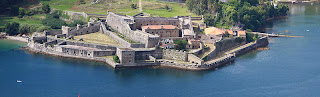
The castle of
San Filipe secures the entrance of the harbour
In the 14th century
Henry II gave the town to the powerful
Andrade family.
[6]
In 1568
[7]
a fire reduced to rubble the old medieval town; in the same period some
parts of the existing fortifications at the entrance of the
estuary were built.
[8] As a naval base, at that time the town was
considered more important as a
Royal Arsenal than as a safe harbour.
With the arrival of the
Bourbons in the 18th century, Ferrol became a leading naval centre.
[9] Ferrol was made
Capital of the Maritime Department of the North, formed under
Ferdinand VI and
Charles III for the defence of the
Spanish Colonial Empire in America. Rapid improvements followed, notably under the leadership of the
Marquis of Ensenada,
and the position of Ferrol was made almost unassailable from the sea,
the difficulties of disembarking troops on its precipitous coast being
strengthened by a renewed line of fortresses and newly built castles,
including that of San Carlos.
The
Royal Dockyards of
A Graña and Ferrol, built between 1726–1783,
[10] produced ships protected with copper sheets from the rolling mills of Xubia. In 1772,
The Spanish Royal Academy of Naval Engineers of Ferrol, the first such academy in Spain, was created.
Ferrol was virtually impossible to
blockade
in the age of sail, as strong westerly winds would take any blockading
force away along the treacherous north coast of Spain where they had no
safe haven. The geography of Ferrol meant that an entire Spanish fleet
could slip out on a single tide. By the time the British were able to
resume the blockade, the Spanish would be safely away and out to sea.
Despite these advantages, a decline set during the reign of
Charles IV, and in 1800, during the
Ferrol Expedition (1800),
after the defences had been reduced, a British fleet of 109 vessels
landed troops on the beach of Doniños to take the Castle of San Felipe.
Although only equipped with meagre artillery, the castle's small defence
force under the command of
Count Donadio
together with a sizable number of volunteer citizens of Ferrol,
successfully resisted the attack and the fleet withdrew. The alliance
with the
United Kingdom during the
Peninsular War
of 1808-14 failed to prevent the deterioration in the town’s fortunes.
The arsenals and fortresses were abandoned and they were easily occupied
by the French in
1809.

Aerial view of the city (2009)
Under
Ferdinand VII,
Ferrol lost its title of capital. New activities sprang up, however, in
the mid-19th century, during the administration of the
Marquis de Molina,
[11] Spanish Minister for Naval affairs, which included amongst other political successes the construction and launch in the
Royal Dockyards of Ferrol of
Spain's first steam propelled ship in 1858.
The second half of the 19th century brought to the Royal Dockyards of
Ferrol not just plenty of work but social and political tensions which
ended up in the failed republican uprising of 1872.
[12]
Ten years after the
Spanish-American War of 1898,
[13][14] in which Spain lost
Cuba and the
Philippines, the
Antonio Maura Government, in an attempt to restore the Spanish Navy and Spanish shipbuilding industry hired the
Spanish Society for Naval Construction, whose major investors were the British firms
John Brown,
Vickers and
Armstrong[disambiguation needed][15] the
shipbuilding yards,
workshops,
foundries and
dry docks in Ferrol.
For a period of sixteen years, all the technicians were exclusively
British, and the situation was not altered till 1925 when the management
was taken over by Spanish engineers, as one of the new policies
introduced by the then newly created government, including ministers
both civil and military, of the dictator
Miguel Primo de Rivera (1923–1930). The arrival of the
British coincided with the construction of a
local electric-powered trolley streetcar’s line (1924–1961).
[16]
In sight of the outbreak of the Spanish Civil War, and because there was fear of social unrest in the naval station, the
Foreign Office in
London,
[17][18] organized a ship to repatriate all the remaining British citizens and on 22 July 1936
HMS Witch (D89)[19] departed from Ferrol back to Britain. At the outbreak of the
Spanish Civil War (1936–1939) the shipbuilding yards, workshops, foundries and dry docks in Ferrol were taken over by the state and fully
nationalized in 1945 under the name "Bazàn", later renamed "IZAR", and, starting from January 2005,
Navantia. The town was the birthplace of dictator
Francisco Franco, after whom the city was officially known as
El Ferrol del Caudillo from 1938 to 1982. The end of the dictatorship and the arrival of
democracy in 1978 did not help Ferrol,
[20][21] and from 1982 to the early 1990s, the city confronted numerous problems due to a decline in the
naval sector. The beginning of the new millennium however has been a time of economic expansion and prosperity in general.
[22] A new motorway and an
outer-port[23] have been built.
Ferrol hosted the large
NATO Maritime Exercise Loyal Mariner (
RN) in June 2008.
[24]
Climate


 España
 Galicia
 La Coruña


